
Industrial Robotics • Precision Transmission • United Kingdom
Gear Chains for Industrial Robot Joint Drives: Engineering Precision in Automated Motion Systems
How inverted-tooth gear chains and advanced silent chain technology are transforming robotic joint actuation across UK manufacturing, automotive assembly, and aerospace production lines.
Why Gear Chains Are Gaining Ground in Robot Joint Actuation
 In the fast-evolving landscape of industrial automation, robotic arm performance depends on far more than software intelligence or sensor precision. The mechanical transmission that connects a servo motor to a robot’s moving joint is the hidden backbone of every pick-and-place cycle, every welding arc, and every assembly operation running inside factories across the United Kingdom and beyond. While harmonic drives and planetary gearboxes have long dominated robotic joint design, a growing number of robotics engineers and OEM integrators are now turning to gear chains — specifically inverted-tooth silent chains — to address a distinct set of mechanical challenges that conventional reducers cannot always solve economically or efficiently.
The rationale is straightforward: in certain robot configurations, particularly delta robots and long-reach articulated arms, mounting every actuator directly at the joint creates excessive inertia at the end effector. By relocating the servo motor to the robot’s fixed base and transmitting torque through precision gear chains, engineers can dramatically reduce the moving mass at the wrist or elbow joint. The result is faster acceleration, shorter cycle times, lower energy consumption, and — when the chain system is designed correctly — repeatability well within the ±0.05 mm envelope that modern manufacturing demands. For UK-based integrators working under tight floor-space constraints and exacting quality standards, gear chains present a compelling alternative worth serious engineering evaluation. This article examines how gear chains are being deployed in robotic joint drive systems across UK industry, from automotive welding cells to aerospace component handling.
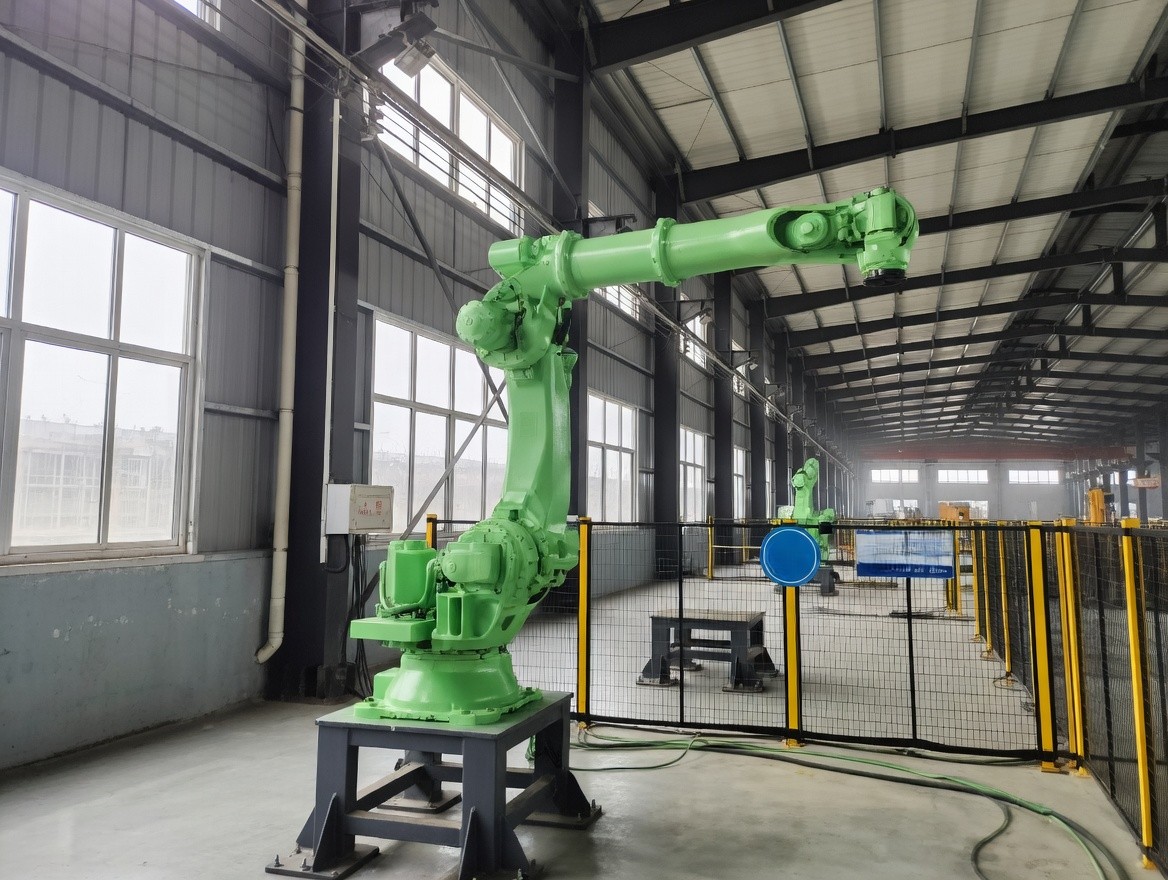
 Precision inverted-tooth gear chains integrated into a six-axis industrial robot base assembly.
Repeat Positioning Accuracy: The Central Engineering Challenge
 Any mechanical engineer who has worked on robotic joint assemblies understands that the most critical performance metric is repeat positioning accuracy. A six-axis articulated robot performing spot welding on an automotive body-in-white line in Sunderland or assembling electronics in a Cambridge clean-room must return to the same spatial coordinate within ±0.05 mm — thousands of times per shift, millions of times per year. Achieving that consistency through a chain-driven transmission requires overcoming three distinct sources of error: pitch accumulation tolerance across the chain length, elastic stretch under varying load, and backlash between the chain and its mating sprockets.
Gear chains designed for robotic applications tackle these challenges through a layered engineering approach. The gear chain itself is manufactured to far tighter dimensional tolerances than standard industrial-grade roller chains. Cumulative pitch error over a 300 mm span is typically held below ±0.02 mm, compared with ±0.15 mm for a general-purpose transmission chain of similar size. The link plates and pins are ground rather than simply blanked and heat-treated, ensuring that each articulation point moves with minimal play. Pre-tensioning mechanisms built into the robot’s base frame apply a controlled static load that eliminates the slack-side catenary sag responsible for the largest share of positional backlash. Combined with zero-backlash tensioner pulleys, these refinements bring the total system backlash of a well-designed gear chain drive below 0.03 mm — comfortably within the precision budget of most industrial robots.
Inverted-Tooth Silent Chains vs Roller Chains in Robotic Joints
 Not all gear chains are created equal when it comes to precision motion control. In traditional conveyor or power-transmission applications, the standard roller chain — with its cylindrical rollers engaging radiused sprocket pockets — performs reliably and economically. Yet in a robot joint drive, the polygon effect inherent in roller chain engagement introduces velocity ripple that directly degrades positioning accuracy. Each time a roller seats into a new sprocket tooth, the effective pitch radius shifts slightly, producing a periodic speed fluctuation whose amplitude grows with decreasing sprocket tooth count. For a compact robot joint running a 19-tooth drive sprocket, this velocity variation can reach 1.4% — an unacceptable disturbance in a high-precision servo loop.
Inverted-tooth gear chains, commonly known as silent chains, address this limitation through a fundamentally different engagement geometry. Instead of cylindrical rollers, each link carries a pair of toothed plates that mesh with straight-sided sprocket teeth in a conjugate profile. The contact line moves smoothly across the tooth flank, virtually eliminating the abrupt chordal rise-and-fall pattern of roller engagement. The polygon effect is reduced by an order of magnitude — typically below 0.1% velocity variation on a similarly sized sprocket — producing the kind of smooth, jitter-free motion that robotic servo controllers require. This is why inverted-tooth gear chains have become the transmission of choice for robot builders who need remote joint actuation without sacrificing dynamic accuracy. For UK-based integrators evaluating gear chains against direct-drive alternatives, the performance data speaks for itself.
Key Advantages of Gear Chains in Robotic Drive Systems
◆ Reduced End-Effector Inertia
Relocating the servo motor to the robot base and transmitting power via gear chains can cut moving joint mass by 35–50%, enabling faster acceleration profiles and shorter cycle times in high-speed pick-and-place cells. This is particularly advantageous in delta robot configurations used across UK food packaging and pharmaceutical lines.
◆ Ultra-Low Backlash Transmission
Precision-ground link plates combined with pre-tensioned chain runs deliver system backlash below 0.03 mm, ensuring that the robot maintains ±0.05 mm repeat positioning even after millions of operational cycles. The zero-backlash tensioner eliminates slack-side oscillation that plagues conventional setups.
◆ Smooth Velocity Profile
Silent-type gear chains produce velocity ripple below 0.1%, minimising the polygon effect that causes micro-vibrations in roller chain drives. This directly improves weld seam quality, adhesive bead consistency, and vision-guided inspection accuracy on the production floor.
◆ Extended Service Life & Lower Maintenance
Case-hardened alloy steel pins and high-fatigue-strength link plates give robotic-grade gear chains a rated service life exceeding 15,000 operating hours before measurable pitch elongation triggers replacement. Sealed lubrication options reduce scheduled downtime on 24/7 production shifts common in UK automotive plants.
◆ Design Flexibility & Remote Actuation
Gear chains accommodate centre distances from 150 mm to over 2,000 mm without the alignment sensitivity of shaft couplings or the weight penalty of gear trains. This allows robot designers to route transmission paths around structural members, cable looms, and pneumatic services — a significant advantage in space-constrained cells.
Technical Specifications: Robotic-Grade Gear Chains
The following table summarises the key performance parameters of precision gear chains engineered for industrial robot joint drives. These values represent typical specifications across our standard product range and may be further refined through our bespoke customisation service for specific robot models and load profiles.
| Parameter | Silent Chain (Robotic Grade) | Standard Roller Chain |
|---|---|---|
| Chain Pitch | 6.35 mm – 15.875 mm | 6.35 mm – 25.4 mm |
| Cumulative Pitch Error (per 300 mm) | ±0.02 mm | ±0.15 mm |
| System Backlash | < 0.03 mm | 0.10 – 0.30 mm |
| Velocity Ripple (Polygon Effect) | < 0.1% | 1.0 – 1.5% |
| Maximum Operating Speed | Up to 8,000 rpm (drive sprocket) | Up to 4,500 rpm |
| Rated Tensile Strength | 12 kN – 85 kN | 8 kN – 110 kN |
| Service Life (before pitch elongation >1%) | > 15,000 hours | 6,000 – 10,000 hours |
| Operating Temperature Range | −20 °C to +150 °C | −10 °C to +120 °C |
| Material (Link Plates) | Alloy steel, case-hardened HRC 58–62 | Carbon steel, HRC 40–50 |
| Pin Material & Treatment | Precision-ground alloy steel, surface-nitrided | Through-hardened carbon steel |
| Noise Level (at 3,000 rpm) | ≤ 62 dB(A) | 72 – 80 dB(A) |
Materials, Manufacturing Process, and Operating Principles
The performance of any precision gear chain begins at the metallurgical level. Link plates for robotic-grade gear chains are stamped from chromium-molybdenum alloy steel strip, then individually case-hardened in a controlled-atmosphere furnace to achieve a surface hardness of HRC 58–62 while retaining a tough, ductile core. This dual-hardness profile gives the plates exceptional resistance to both surface wear and fatigue cracking under the high-frequency cyclical loads characteristic of robotic joint operation. Pins are precision-ground from bearing-quality alloy steel and surface-nitrided to create a thin, extremely hard nitrogen-diffusion layer that resists galling during high-speed oscillation in the bushing bore.
In operation, the inverted-tooth gear chain wraps around a drive sprocket mounted on the servo motor output shaft (or, more commonly, on the output shaft of a planetary gearbox that provides the initial speed reduction). The chain runs along a tensioned path to a driven sprocket fixed to the robot joint shaft. As the drive sprocket rotates, the toothed link plates engage the sprocket teeth in a meshing action analogous to gear engagement — hence the designation “gear chain.” The conjugate tooth profile ensures that each link enters and exits the sprocket wrap arc with smooth, continuous velocity transfer, minimising the chordal velocity variation that causes vibration in roller chains. A spring-loaded or pneumatically actuated tensioner maintains constant preload on the slack side, compensating for thermal expansion and any micro-elongation that develops over the chain’s service life. In demanding applications where even the tensioner’s compliance budget is too loose, dual-strand gear chains with staggered pitch phasing can be used to virtually cancel the residual polygon effect entirely. This dual-strand gear chain configuration is increasingly popular among UK robot builders targeting sub-micron repeatability envelopes.
Application Scenarios Across UK Industry Sectors
Gear chains for robot joint drives are not a universal replacement for direct-drive harmonic reducers — they are a complementary solution that excels in specific robot configurations and operational profiles. Understanding where gear chains deliver the greatest return requires an application-level perspective grounded in real factory conditions across key UK manufacturing sectors.
▶ Automotive Body-in-White Assembly (West Midlands, Sunderland)
Large articulated robots with extended reach (2,500–3,200 mm) performing spot welding on car body panels benefit from gear chain drives on the J3 (elbow) and J2 (shoulder) axes. Relocating the 3–5 kW servo motors to the robot pedestal and running silent-type gear chains to the upper arm joints reduces the cantilevered mass, cutting base motor energy consumption by up to 22% per cycle. Plants in the West Midlands and the Nissan facility in Sunderland run these robots at 45–55 cycles per minute, and even a fractional improvement in dynamic response translates to measurable throughput gains over a three-shift day.
▶ Food & Pharmaceutical Packaging (South East England, Scotland)
Delta robots used for high-speed pick-and-place in food packaging lines — common in factories across Kent, Essex, and the Scottish Central Belt — are a natural application for gear chain drives. The parallel-linkage architecture of a delta robot already separates the actuators from the moving platform; gear chains extend this principle by providing a lightweight, backlash-free transmission path from base-mounted motors to the linkage pivot points. With cycle rates exceeding 120 picks per minute, the reduction in moving mass afforded by precision gear chains directly improves the robot’s ability to track complex motion profiles without overshooting waypoints.
▶ Aerospace Component Handling (Bristol, Derby, North Wales)
Robotic systems used for handling composite layup tools, drilling carbon-fibre panels, and positioning turbine blades in aerospace manufacturing require both high load capacity and exceptional positional accuracy. Factories operated by major aerospace manufacturers in Bristol, Derby, and Broughton (North Wales) deploy large-payload robots where gear chain drives offer a favourable balance of torque density and transmission stiffness. The gear chains’ inherent tolerance to misalignment also simplifies installation on large robot frames where thermal growth and structural deflection would otherwise demand frequent recalibration of rigid coupling-based drive trains.
▶ Warehouse Logistics & E-Commerce Fulfilment (Midlands Corridor)
The explosive growth of e-commerce fulfilment centres along the M1 and M6 corridors has driven demand for robotic palletising and order-sorting systems that run around the clock. Gear chains offer these operations a maintenance-friendly drive solution with predictable wear characteristics: gear chain elongation can be monitored through simple span-measurement checks during scheduled breaks, and replacement can be performed by in-house maintenance technicians without specialist alignment equipment — a significant advantage over harmonic drives that require factory-trained service engineers and precision shimming procedures.
Complementary Products: Building a Complete Robotic Drive Train
A gear chain is only one component within a broader power transmission architecture. In most robotic joint applications, the gear chain works in concert with several other precision mechanical elements to deliver the required torque, speed, and accuracy at the joint output. Our product range includes the complete ecosystem of components that integrators need to build a turnkey robotic drive system centred on gear chains:
Precision Planetary Gearboxes
Mounted between the servo motor and the drive sprocket, planetary gearboxes provide the initial speed reduction (typically 5:1 to 25:1) and torque multiplication. Our low-backlash planetary reducers are specifically matched to our gear chain pitch ranges for optimal system performance.
Rigid Couplings & Shaft Connections
Where the driven sprocket connects to the robot joint shaft, a high-precision rigid coupling ensures zero-backlash torque transfer from the gear chain to the output axis. Our range of split-clamp and flange-type rigid couplings is available in bore sizes from 8 mm to 60 mm, with concentricity guaranteed within 0.005 mm TIR.
Harmonic Drive Units & Cycloidal Reducers
For robot joints where direct-mount reduction is preferred over remote chain actuation — particularly wrist axes (J4, J5, J6) — we supply harmonic drive units and cycloidal speed reducers that integrate seamlessly with our gear chain-driven upper axes, giving integrators a single-source solution for the entire robot arm.
Sprockets & Tensioner Assemblies
Matched sprockets manufactured from hardened tool steel, along with pre-loaded tensioner assemblies with adjustable preload ranges, complete the gear chain drive package. Every sprocket is profile-ground to match the specific gear chain pitch and tooth form, ensuring optimal meshing performance from day one.
Customer Success: Real-World Deployments
Case Study: Robotic Welding Cell Upgrade — Automotive Tier-1 Supplier, West Midlands, UK
Industry: Automotive Components | Location: Coventry, England | Application: Spot Welding
A Tier-1 automotive supplier operating six robotic spot-welding cells in Coventry was experiencing inconsistent weld nugget quality on a new aluminium-intensive body platform. Root-cause analysis identified excessive vibration at the J2 and J3 joints during high-speed repositioning as the primary contributor to electrode tip misalignment. The existing harmonic drive units on these joints, while accurate under static conditions, exhibited compliance-induced oscillation during aggressive acceleration ramps that the servo controller could not fully damp.
Working with our applications engineering team, the integrator redesigned the J2 and J3 drive trains to use pre-tensioned inverted-tooth gear chains running from base-mounted servo motors through precision planetary gearboxes. The gear chain retrofit reduced the moving mass on each joint by 41%, which allowed the servo gains to be increased without triggering resonance. Weld quality defects dropped by 68% within the first production month. The robot’s effective cycle time fell from 4.2 seconds to 3.7 seconds per weld point — a gain that, across six cells running two shifts, added over 14,000 additional welds per week to the line’s capacity without a single additional robot.
What Our Clients Say
“We trialled several transmission options before settling on the silent-type gear chains for our delta robots. The reduction in velocity ripple was immediately visible on the servo drive’s FFT display — the dominant polygon-effect frequency peak virtually disappeared. Our pick rate went up 9% without changing any motion profile parameters.”
— James Thornton, Senior Automation Engineer, Food Packaging Integrator, Reading, UK
“The custom chain lengths and matched sprocket sets saved us two weeks of commissioning time compared with previous projects where we had to source drive components from three different vendors. Having a single technical contact for the entire chain drive package made the project run far more smoothly.”
— Dr. Anya Kowalski, Robotics Programme Manager, Aerospace MRO Facility, Derby, UK
“Maintenance simplicity was the deciding factor for us. Our technicians can measure chain elongation with a vernier calliper during a 15-minute break and have a replacement chain fitted within an hour. With harmonic drives, we were waiting three days for a factory-trained engineer. In a 24/7 fulfilment centre, that downtime is measured in thousands of pounds.”
— Paul Griffiths, Head of Maintenance, E-Commerce Fulfilment Centre, Northampton, UK
Our Manufacturing Capability & Custom Engineering Service
With over 18 years of specialised experience in precision chain transmission engineering, our factory operates dedicated production lines for robotic-grade gear chains, silent chains, and matched sprocket assemblies. Our vertically integrated gear chain manufacturing process — from raw material inspection through stamping, heat treatment, grinding, assembly, and final dimensional audit — gives us complete control over every quality-critical step. We hold ISO 9001:2015 certification and are currently progressing towards IATF 16949 accreditation to meet the supply-chain requirements of UK and European automotive OEMs.
Our custom engineering service goes far beyond catalogue selection. For robotic joint drive applications, we routinely deliver bespoke gear chain designs tailored to the customer’s specific robot model, payload, cycle time, and environmental conditions. This includes custom pitch dimensions, non-standard chain widths, special surface treatments (nickel plating for clean-room environments, black-oxide for laser-cell compatibility), and pre-assembled chain-and-sprocket kits shipped ready for drop-in installation. Minimum order quantities start at just 10 units for prototype and pre-series validation, scaling to volume production without lead-time disruption. Every custom order is supported by a dedicated applications engineer who works directly with the customer’s design team from initial concept through to on-site commissioning support.
Serving Robotics Integrators Across the United Kingdom
 We supply gear chains and complete drive train components to robotics integrators, OEM robot builders, and end-user manufacturers throughout England, Scotland, Wales, and Northern Ireland. Our UK distribution partnerships enable rapid delivery of gear chains to major industrial centres including the West Midlands automotive corridor, the advanced manufacturing clusters around Derby, Bristol, and Cambridge, the food and beverage processing regions in East Anglia and central Scotland, and the growing logistics and fulfilment hub along the M1/M6 motorway network. Standard catalogue products ship from our European stock within 3–5 working days to any UK mainland address; custom-engineered chain assemblies are typically delivered within 3–4 weeks from order confirmation, including full dimensional certification and test reports compliant with BS and EN transmission chain standards.
For integrators managing multi-site roll-outs across the UK, we offer blanket order agreements with scheduled call-off deliveries, ensuring that gear chain sets arrive at each installation site precisely when the commissioning schedule demands — not weeks early consuming warehouse space, and never late holding up a production launch. Our technical support team is available for on-site visits to assist with chain selection, drive layout optimisation, and installation verification anywhere in Great Britain.
Frequently Asked Questions
What is the typical cost of precision gear chains for industrial robot joint drives supplied to UK factories?
Pricing for robotic-grade gear chains depends on chain pitch, width, length, surface treatment, and order volume. For a single silent-type chain set sized for a mid-range six-axis robot (J2/J3 axes), UK customers can typically expect a unit price ranging from £180 to £650 including matched sprockets. Volume orders of 20 sets or more attract significant discounts. Contact our sales team at [email protected] for a detailed quotation tailored to your specific robot model and production schedule.
Where can I find a reliable gear chain supplier for delta robots used in food packaging lines in England?
We specialise in supplying precision gear chains to food-industry robotics integrators throughout England, with particular experience supporting packaging operations in the South East, East Anglia, and the Midlands. Our chains are available in food-safe surface treatments including nickel plating and FDA-compliant lubricants. We offer free application reviews for delta robot drive layouts and can ship stock items within 3–5 working days to any UK address.
How do I get a quote for custom-length gear chains matched to our specific robotic welding cell in the West Midlands?
Getting a custom quote is straightforward. Email your robot model, axis configuration, required chain length, and load data to [email protected]. Our applications engineering team will review your specifications, recommend the optimal chain pitch and width, and return a formal quotation within two working days. We regularly support automotive integrators across the West Midlands and can arrange site visits in the Coventry, Birmingham, and Wolverhampton area if on-site measurement is required.
Which type of gear chain offers the best repeat positioning accuracy for six-axis robot arms in aerospace manufacturing?
Inverted-tooth silent chains are the preferred choice for aerospace robotic applications where repeat positioning accuracy below ±0.05 mm is required. Their conjugate tooth profile eliminates most of the polygon effect inherent in roller chains, producing velocity ripple below 0.1%. When combined with pre-tensioned runs and zero-backlash tensioners, silent-type gear chains deliver system backlash under 0.03 mm — well within the accuracy budget of precision aerospace manufacturing robots used at facilities in Bristol, Derby, and North Wales.
What is the expected service life of robotic-grade gear chains before replacement is needed on a 24/7 production line?
Under normal operating conditions with proper lubrication and tensioning, our robotic-grade gear chains are rated for a minimum service life of 15,000 operating hours before pitch elongation exceeds the 1% replacement threshold. On a typical UK factory running three eight-hour shifts, seven days a week, this equates to approximately two and a half to three years of continuous operation. Regular elongation checks during scheduled maintenance windows can help optimise replacement timing and avoid unplanned downtime.
Can you supply gear chains along with planetary gearboxes and rigid couplings as a complete drive package for our robot integration project?
Absolutely. We offer fully integrated drive train packages comprising precision gear chains, matched sprocket sets, pre-loaded tensioner assemblies, low-backlash planetary gearboxes, and high-precision rigid couplings — all engineered to work together as a system. Purchasing the complete package from a single supplier eliminates interface compatibility risks and simplifies your procurement process. Contact [email protected] with your robot model and performance requirements, and our engineering team will configure a turnkey solution.
Ready to Upgrade Your Robotic Joint Drives?
Speak with our applications engineering team about precision gear chains for your robot project. We serve integrators and OEMs across the United Kingdom with rapid delivery and full technical support.
© 2026 gear-chains.top | Precision Transmission Solutions for Industrial Automation | Serving the United Kingdom & Europe | edit by gzl