Mô tả
 Selecting the right stainless steel chain for a production environment is rarely a simple catalogue exercise. British manufacturing teams — across food, pharmaceutical, marine, and chemical sectors — require components that hold dimensional accuracy through repeated thermal cycling, aggressive chemical washdowns, and sustained mechanical loading. The RS-RESS series from Ever Power answers that requirement directly. Every link plate, roller, bushing, and pin in this stainless steel chain range is manufactured to ISO 606 and BS 228 tolerances, using AISI 304 or AISI 316 stainless steel selected to match the specific corrosion chemistry of the intended application. The result is a power transmission product that consistently outlasts carbon-steel alternatives in wet, saline, or oxidising environments — reducing unplanned stoppages, cutting lubrication costs, and delivering measurable improvements in overall equipment effectiveness for UK plants.
The engineering behind the RS-RESS series draws on more than 18 years of live application data gathered from clients in the meat, poultry, dairy, seafood, bulk pharmaceutical, and offshore sectors. That experience feeds directly into dimensional decisions, surface-treatment specifications, and the lubrication guidance we provide with every delivery. Stainless steel chain procured without that application context — even nominally identical product — frequently underperforms because the chain specification has not been matched to operating temperature, side-load profile, and chemical exposure. Our technical team works with UK buyers before the purchase decision, not after a failure.
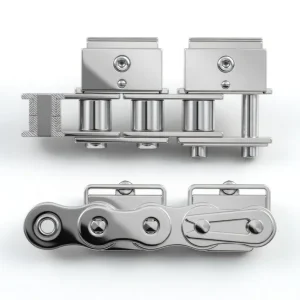
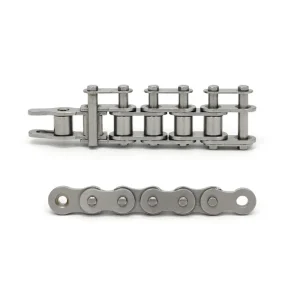
Ever Power RS-RESS Stainless steel sharp top chains — precision-ground, corrosion-resistant, ISO 606 compliant
Why UK Engineers Specify the RS-RESS Series
Six performance characteristics that define this stainless steel chain for demanding British industrial applications.
Exceptional Corrosion Resistance
AISI 316 stainless steel chain with its molybdenum content resists chloride-induced pitting that destroys standard chain in food factories, coastal processing plants, and marine wash environments throughout the UK. Grade 304 is available where chloride exposure is lower, reducing material cost while maintaining excellent general corrosion performance.
ISO 606 Dimensional Accuracy
Pins, bushings, and rollers are precision-ground to tight tolerance bands that guarantee consistent pitch engagement with matching sprockets. This dimensional control minimises vibration and backlash, particularly important on indexing conveyors and packaging machinery where positional accuracy directly affects product quality and rejection rates.
Wide Thermal Operating Range
Reliable performance from -20 °C to +400 °C makes the RS-RESS stainless steel chain equally suited to blast-freezer conveyors in Lincolnshire cold stores, high-temperature tunnel ovens in bakeries, industrial dryers, and continuous-process furnaces. No thermal expansion surprises, no embrittlement at low temperatures.
Food & Pharma Grade Compliance
Compatible with NSF H1 food-grade lubricants and compliant with EU Regulation (EC) No 1935/2004 on materials in contact with food. In pharmaceutical contexts, the 316L low-carbon variant supports FDA and EU GMP validation with full material traceability certificates, surface roughness data, and dimensional inspection reports supplied as standard.
Extended Fatigue Life
Shot-peening of all link plates introduces compressive residual stress at the surface layer, increasing resistance to fatigue crack initiation by up to 30% in high-cycle applications. UK FMCG lines running 20+ hours per day at speeds above 0.5 m/s see this benefit most clearly — measurably fewer link-plate fractures and a longer interval between scheduled replacements.
Same-Day UK Despatch Available
Standard RS-RESS sizes are maintained in ready-to-ship inventory. Orders confirmed before 14:00 GMT typically dispatch the same business day under DDP Incoterms to any UK delivery address, minimising line-stoppage risk and emergency maintenance cost for engineering teams across England, Scotland, Wales, and Northern Ireland.
Technical Specifications — RS-RESS Series

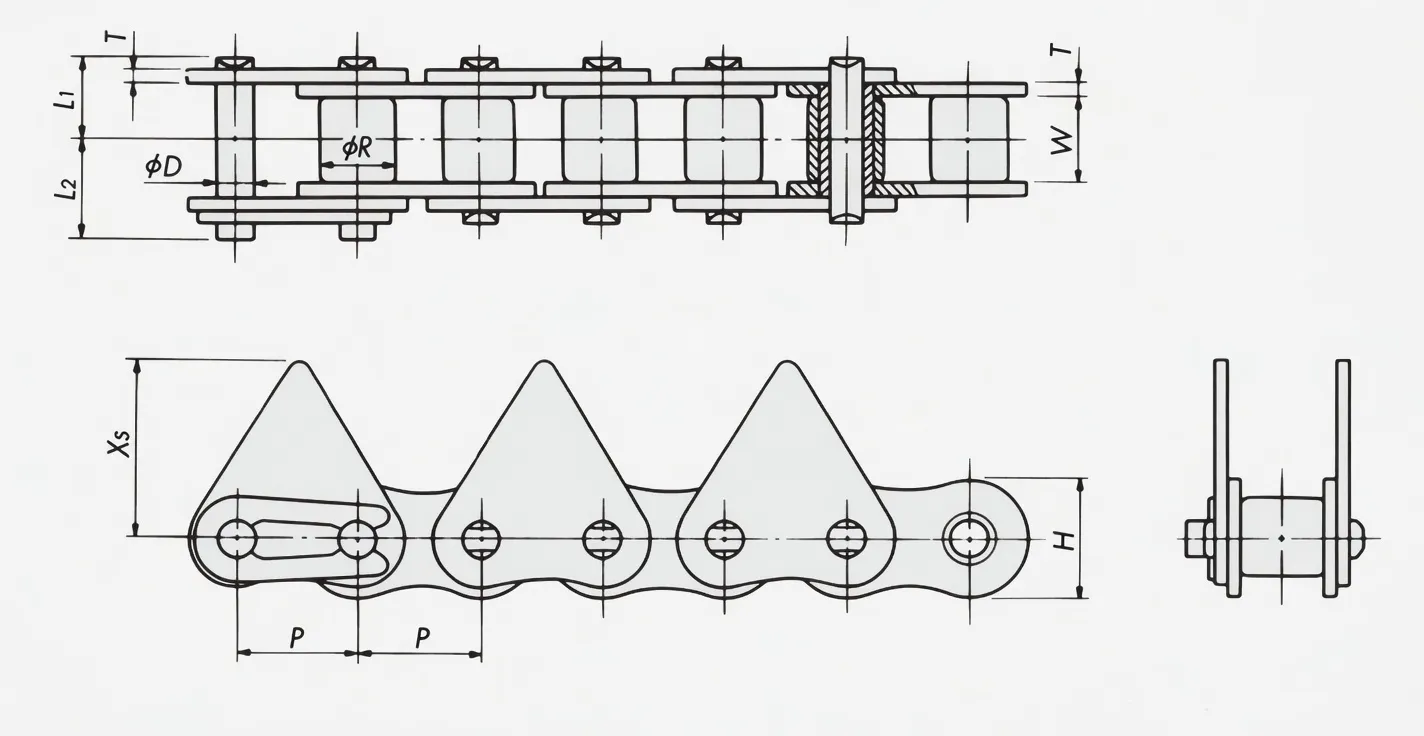 All dimensions in millimetres (mm). Verified against ISO 606 and DIN 8187 standards.
P = Pitch | W = Inner Width | R = Roller Diameter | D = Pin Diameter | L1 = Inner Link Length | L2 = Outer Link Length | H = Plate Height | T = Plate Thickness | XS = Overall Width. All dimensions in mm.
How the RS-RESS Chain Works — Material & Operating Principle
The stainless steel sharp top chains operates through articulating link pairs joined by precision-fit pin-and-bushing assemblies. As the chain wraps around a drive sprocket, each link’s hardened stainless steel roller rotates freely on its bushing, presenting a rolling-contact surface to the sprocket tooth rather than a sliding surface. This fundamental mechanical difference reduces friction by a factor of 3 to 5 compared to slide-contact chain types, cutting energy consumption, reducing heat generation, and extending both chain and sprocket life simultaneously. In UK food factories where energy cost monitoring is now standard practice, this efficiency advantage translates into measurable monthly savings across large conveyor systems.
Material integrity across the entire chain assembly is paramount. The RS-RESS series uses the same stainless steel grade for all components — inner plates, outer plates, pins, bushings, and rollers — eliminating the galvanic corrosion cells that form wherever two dissimilar metals meet in an electrolyte such as salt water or acidic cleaning solution. Outer plates are shot-peened to a controlled depth, introducing compressive residual stress that resists fatigue crack nucleation at the pin-hole stress-concentration zones. This process step is particularly valuable in high-cycle applications such as automated packing lines, bottling plant conveyors, and robotic pick-and-place systems where chains articulate millions of times per week.
Industries & Applications Across the United Kingdom
🐟 Fish & Seafood Handling
💊 Pharmaceutical Production
🧴 Beverage Filling Lines
⚗️ Chemical Processing
🚢 Marine & Offshore
🏭 Automotive Wash Systems
🌾 Agricultural Machinery
❄️ Cold-Store Conveyors
🔬 Laboratory Automation
Client Success Stories
Verified outcomes from procurement managers and plant engineers who chose Ever Power stainless steel chain.
Northumberland Protein Foods Ltd
Food Processing · North East England, UK
“After persistent rust failures on our main slaughter-line conveyor with our previous supplier, we switched to Ever Power RS60-RESS stainless steel chain. Eighteen months of twice-daily high-pressure alkaline washdowns later, we have not replaced a single link. No corrosion, no measurable elongation, no unplanned stoppages. Total cost of ownership is down roughly 40% compared with the carbon-steel chain and the downtime it caused.”
— James Thornton, Engineering Manager
MedLine Pharma Solutions GmbH
Pharmaceutical Manufacturing · Frankfurt, Germany
“Our tablet-coating drum drives required stainless steel chain that could pass FDA and EU GMP inspection without generating particulate contamination. The Ever Power RS50-RESS 316L chains completed qualification in under two weeks. After 18 months of continuous operation — no dimensional drift, no particle shedding, no stoppages. We standardised on this product across all four filling lines as a direct result.”
— Dr. Katrin Bauer, Validation Engineer
Caledonian Marine Services Ltd
Marine Maintenance · Aberdeen, Scotland, UK
“Offshore North Sea conditions are brutal. We trialled Ever Power RS80-RESS stainless steel chain on our vessel anchor-handling deck equipment — constant salt spray, sub-zero winters, and shock loading. After two full seasons: only superficial surface marks, no measurable pitch elongation, no corrosion pitting. We have now standardised the product across 12 vessels and could not be more satisfied with both performance and technical support.”
— Alistair McKenzie, Fleet Maintenance Director
Manufacturing Capability & Custom Chain Engineering
Ever Power operates a dedicated stainless steel chain production facility, entirely segregated from our carbon-steel lines to prevent any risk of iron contamination — a detail that matters greatly to pharmaceutical and food customers subject to third-party audit. Our CNC precision-grinding machines, closed-loop heat-treatment furnaces, and automated assembly cells operate under an ISO 9001:2015-certified quality management system. Every finished chain is subjected to tensile testing, elongation measurement, and dimensional inspection before release, with test data recorded in a traceable production record that ships with the goods.
Catalogue chain is the starting point, not the ceiling. Our bespoke engineering service means UK buyers can specify — and receive — stainless steel chain that has been engineered precisely for their conveyor geometry, load profile, and operating environment. We produce attachment chain with A1, A2, K1, K2, and fully custom bent-tab or extended-pin profiles; hollow-pin chain for cross-bar and pin-registration conveyor systems; side-flex variants for curved tracks; and double-pitch chain for long-centre drives. Development lead times for custom stainless steel sharp top chains typically run four to six weeks from approved drawing to first-article delivery, complete with full dimensional, tensile, and surface-finish test reports. OEM private-label packaging, custom part numbering, and co-branded documentation are also available for distributors and system integrators operating in the UK market.
✓ Attachment Chain
A1, A2, K1, K2 and fully custom bent-tab or extended-pin profiles
✓ Hollow Pin Chain
Positive-drive slat, cross-bar, and pin-registration conveyor applications
✓ Double-Pitch Chain
Up to 2x standard pitch for long-centre drives and light-load conveyors
✓ OEM Private Label
Custom packaging, part numbers, and documentation for UK distributors
Frequently Asked Questions
Common questions from UK plant engineers and procurement managers about stainless steel sharp top chains.
What is the real difference between AISI 304 and AISI 316 stainless steel chain, and which grade should a UK food manufacturer choose for daily CIP washdown environments?
AISI 304 stainless steel chain offers good general corrosion resistance and handles most dry or mildly wet food processing conditions found in UK factories without difficulty. AISI 316 adds 2–3% molybdenum, which substantially raises resistance to chloride-induced pitting corrosion — the failure mode that destroys chain on seafood processing lines, in dairy CIP systems using hypochlorite solutions, and on equipment exposed to salt brine or acidic marinades. For any UK food manufacturer running daily CIP cycles or processing saline products, AISI 316 stainless steel chain is not just preferable — it is the material that makes the economics of stainless steel worthwhile, because it is the grade that actually survives the environment.
How much does stainless steel sharp top chains cost compared to carbon steel chain, and is the price difference worth paying for a UK production facility with corrosive conditions?
Stainless steel chain typically costs 3 to 5 times more per metre than equivalent carbon steel chain at the point of purchase. In corrosive UK production environments, however, the total cost of ownership calculation almost always favours stainless steel. Plants that switch from carbon steel typically report 35–60% reductions in three-year maintenance cost, driven by eliminating rust failures, cutting lubricant consumption, and reducing line stoppage frequency. If your carbon steel chain is being replaced every three to six months due to corrosion, stainless steel chain running for 18 to 24 months before replacement is almost certainly more economical. Our engineering team is happy to model a cost comparison for your specific application before you commit to a quote.
Where can I find a reliable stainless steel chain supplier in the UK that offers custom chain lengths, fast delivery, and proper technical support for conveyor system design?
Ever Power supplies stainless steel chain to customers across England, Scotland, Wales, and Northern Ireland via DDP delivery. Standard RS-RESS sizes ship from stock, with same-day despatch available on orders placed before 14:00 GMT. Custom chain lengths, attachment configurations, and special grades are manufactured to order, typically with a four-to-six week lead time. Unlike catalogue-only distributors, our applications engineers will review your conveyor geometry and loading conditions before you place an order — selecting the right chain specification, confirming compatible sprocket details, and advising on lubrication intervals at no charge.
Which stainless steel chain size and grade is best suited to a UK pharmaceutical conveyor that needs to pass FDA 21 CFR and EU GMP Annex 1 hygiene validation?
For pharmaceutical conveyors subject to FDA and EU GMP requirements, RS50-RESS (pitch 15.875 mm) and RS60-RESS (pitch 19.05 mm) in AISI 316L low-carbon grade are most commonly validated. The 316L designation is important: its reduced carbon content minimises carbide precipitation in heat-affected zones encountered during passivation and sterilisation procedures. Ever Power supplies 316L stainless steel chain with full material certificates, dimensional inspection data, and surface roughness Ra values — the documentation that supports your IQ/OQ qualification dossier and reduces validation lead time significantly.
How do I work out what length of stainless steel sharp top chains I need for my conveyor, and can Ever Power help me calculate the correct size before I place an order?
Chain length in links is calculated from the formula: L = 2C + (N1 + N2) / 2 + ((N2 – N1) / (2 x 3.1416))^2 x 1 / C, where C is the centre distance in pitches, N1 is the smaller sprocket tooth count, and N2 is the larger. If the result is a non-integer, round up to the nearest even number to accommodate standard connecting links. If you supply Ever Power with your sprocket tooth counts, centre distance in millimetres, required pitch, and approximate load, our engineers will calculate the chain length, advise on standard pre-assembled loop options if applicable, and confirm compatible stainless steel sprocket specifications — all before you commit to any order.
When should a Scottish offshore marine operator plan to replace stainless steel sharp top chains, and what warning signs indicate that failure is approaching on North Sea deck equipment?
Replace stainless steel sharp top chains when pitch elongation exceeds 1.5–2% of nominal length, measured with a calibrated chain-wear gauge across a minimum of 20 consecutive links. Visual warning signs include link-plate cracking at pin holes, visible flat-spots on rollers, audible clicking or juddering as the chain engages the sprocket, and sprocket teeth beginning to show a hooked rather than symmetrical profile. For North Sea offshore equipment subject to shock loading and continuous salt spray, we recommend a six-monthly dimensional inspection as a minimum maintenance interval, supported by a spare loop of correctly sized stainless steel chain held on-vessel for rapid emergency changeover to minimise vessel downtime.
Ready to Specify Stainless Steel Chain for Your UK Application?
Talk to our engineering team today for a no-obligation quote, chain length calculation, or material grade recommendation. We serve buyers across England, Scotland, Wales, and Northern Ireland with DDP delivery and full technical documentation.
📧 Get a Quote — sales@gear-chains
edit by gzl